|
|
Features
 |
|
EXPANDED CONTEXTS OF THE PRAIRIE SCHOOL
At the annual meeting of the Society of Architectural Historians,
held in April 2009 in Pasadena, California, Griffin
Newsletter editor Paul Kruty led a session of four papers
on the subject of “Expanded Contexts of the Prairie
School.” Professor Kruty’s introductory remarks provide
a concise exposition of the state of studies of the Prairie
School and of Griffin scholarship at this moment.
The four papers that followed this introduction were
“Frank Lloyd Wright and the Paradoxical,” by Donald
Hoffmann; “Elmer Grey: Prairie School Disseminated,”
by Chris Czezny Adams; “Marion Alice Parker: Woman
Architect of the Prairie School,” by Nicole Watson;
and “Purcell & Elmslie: Spiritualistic Architecture,” by
Richard Kronick. The session was well-attended and was
followed by a generous question-and-answer period.
Thank you for coming this morning, and welcome
to the session “Expanded Contexts for the Prairie
School.” My name is Paul Kruty, and I teach at the
University of Illinois at Urbana-Champaign. This session
seeks to explore possible lines of research relating
to the Prairie School, a subject of special interest to
me as well as of some significance to the history of
American architecture.
Centered in Chicago and the Midwest during the
early years of the last century, the Prairie School was
a loosely connected group of architects united by a
set of common goals: in general, to reform American
architecture in a number of different ways, including
technical, economic, social, and, of course, formal;
and, specifically, to rid it of what they perceived to be
the evils of the so-called Revival styles—that is, the
adaptation of the canonical Western historic styles
to contemporary buildings. Although this point of
view was quite universally explored, if not accepted by
most architects, throughout the Western world by the
1890s, and included lines of thought developed from
the rational theory of E. E. Viollet-le-Duc, the picturesque
and organic traditions that arose out of the
Gothic Revival, and the values of the English Arts &
Crafts movement, the Chicago group came to it principally
through the figure of Louis Sullivan. Indeed,
as most simply defined, the Prairie School architects
were the followers of Louis Sullivan. It would probably
make more sense to call it “the Sullivan School;”
of course, the most common name used at the time
was “the Chicago School.” By whatever name, they
were individuals, seeking individual solutions, united
by a shared interest in an idea.
We all recognize early Midwestern modernism. Firstly,
because of its simple form, so-called “abstract
geometry,” and its inventive ornament used judiciously.
These are the qualities of Sullivan’s own architecture
and, thus, their source in Prairie School architecture.
Secondly, picturesque and informal composition, at
least in residential architecture, attention to “natural”
materials, and a very general tendency to accentuate
the horizontal—these are features added to the Sullivan
formal vocabulary by Frank Lloyd Wright, yes, but
simultaneously employed by Robert Spencer, Hugh
Garden, George Maher, Myron Hunt, and Elmer Grey,
among others, who sought to develop the implications
of what Henry-Russell Hitchcock called the “Richardsonian
suburban mode.” While Wright was the
supremely gifted member of the Prairie School, and
later rejected any discourse that sought to place him
in the group from 1895 to 1915, in fact he was (particularly
in the early years) one of a “mighty handful”
that worked together to try to transform American
architecture under the aegis both of Louis Sullivan’s
example and his ideas.
As a movement, the Prairie School did not survive the
cultural change engendered by World War I, while its
decorated forms held little appeal for the later architects
of the International Style, despite the common
ancestry of the two modern movements (although
there was occasional recognition of the commonalities
by members of the two groups). Wright’s practice
did survive, as we know, as did Walter Burley
Griffin’s, both with their ideals intact. And to some
extent were responsible for a continuing “Organic Tradition
in American architecture” that still exists. But
these things are not the same as the Prairie School.
The historiography of the Prairie School presents a
curious case. The first generation of scholars, led by
Allen Brooks and followed closely behind by David
Gebhard, Mark Peisch, and then Paul Sprague, laid
the groundwork for the flowering of research in the
late 1960s and through to the early 1980s, when Bill
and Marilyn Hasbrouck published The Prairie School
Review from 1964 to 1976, and major museums, such
as the Art Institute of Chicago and the Princeton
Art Museum in 1972, the Milwaukee Art Museum
in 1978, and the Cooper-Hewitt in 1984, supported
comprehensive exhibitions devoted to the subject.
What happened next was utterly unexpected, if, in
hindsight, perhaps predictable. In a word (three
words, actually): Frank Lloyd Wright. The world was
hit by Wrightomania. Christies couldn’t sell enough
debris looted from Wright’s buildings, and Tom
Monaghan couldn’t buy enough of what they were
selling. Of course, his collection’s purported purpose
and its collection-catalog’s title—Preserving an Architectural
Heritage—was rendered ironic when the collection
was dispersed ten years later, forcing Wright
scholars to travel from London to Tokyo, and to track
down endless wealthy amateur collectors, in order to
reconnect related items that, if once together in the
buildings where they belonged, at least for a time had
been together near Ann Arbor, Michigan.
But the obsession with Wright had consequences for
the Prairie School. As a subject it practically disappeared
from the scholarly discourse, as Wright scholarship
boomed. Thus, books about Prairie School Architecture
in Minnesota, Iowa and Wisconsin of 1982
were replaced with ones entitled Frank Lloyd Wright
in Michigan of 1991, and The Wright State: Frank
Lloyd Wright in Wisconsin of 1992, although that same
year, 1992, there was a second work called Frank Lloyd
Wright & the Prairie School in Wisconsin. But this is
also illustrative of the changing historiographic role of
Wright’s colleagues among the followers of Sullivan:
they were becoming the followers of Wright! Thus the
emergence of a new definition of the Prairie School as
the followers of Frank Lloyd Wright, which is patently
false; but also the concomitant analysis of whether a
building is “Prairie” or not by how much it looks like
a Wright building—which is equally false.
As a consequence, the very significance of the Prairie
School was diminished. When the Chicago Art Institute
returned to the subject in 1995 with a small
show and publication, it now emphasized the regional
meaning rather than the national significance of the
movement. It was no longer Early Modernism FROM
the Midwest, but, as their publication was titled, The
Prairie School: Design Vision FOR the Midwest [emphasis
added].
Yet another skewing of the scholarship grew during
these years: the wholesale appropriation of Sullivan,
Wright and the Prairie School into the Arts & Crafts
Movement, a result, I think, of the continuing rage in
the antiques market for Arts & Crafts products. (Has
there ever been a Grove Park Conference without a
Wright lecture?) And yet the serious case for seeing
the Prairie School, including Wright, principally as
part of the Arts & Crafts cannot be made.
Another consequence of the “Wright Intrusion,” if we
may call it that, is that the scholarship on the Prairie
School remains an unfinished project. Because of the
way individual interests develop, quite early on there
were books on lesser individuals such as Henry John
Klutho, Antonin Nechodoma, and the Trosts, before
there were monographs on Robert Spencer, Dwight
Perkins, and William Drummond. But with the cessation
of sustained scholarly interest, these foundation
studies never appeared, so that now there are still
no published monographs on these three important
figures; with the more recent change in climate regarding
the Prairie School, as we shall see, there is a
Perkins book in the works and I, myself, am presently
completing the study of Robert Spencer.
The new century, while hardly dampening the frenzy
associated with Wright (and apparently the taste for
Coonley Playhouse ties and Robie window paperweights),
has seen a re-awakening of Prairie School
studies, from monographs and exhibitions to internet
sites providing a great deal of information and perhaps
even more mis-information. Two firms have been the
chief recipients of this renewed interest: Purcell &
Elmslie; and the husband-and-wife team of Walter
Burley Griffin and Marion Mahony Griffin. Purcell
& Elmslie have seen a number of museum publications
on their work since the turn of the century, as
well as the posthumous publication in 2006 of David
Gebhard’s seminal work on the firm.
The Griffins in particular have been given nearly their
due. Beginning with major publications on Griffin in
America and the Griffins in India in 1996 and 1997,
as well as a catalogue raisonné of their Australian work,
and continuing with a comprehensive exhibition held
in Sydney, Australia, in 1998, and international symposia
held at the University of Illinois and the University
of Melbourne in 1997 and ’98, writings on their
work now include numerous studies of Griffin’s plan
for the Australian capital city, Canberra, and most
recently a major tome of his complete writings on
architecture, landscape and town planning. For the
past ten years, there has even been a Griffin Society
in America, publishing a newsletter and holding annual
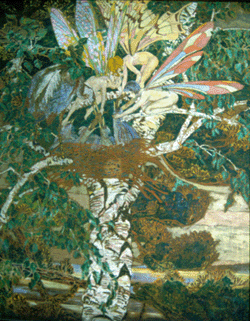
meetings. Marion Mahony Griffin has also had
a separate burgeoning of interest in her work, including
a delightful exhibition at the Block Museum at
Northwestern University in 2005 and a comprehensive
analysis of her work at Millikin Place in Decatur,
Illinois, issued in 2007. She was even “discovered” by
The New York Times last year, more in connection with
her being a woman working for Wright than as a major
figure of the Prairie School.
Finally, the task of synthesizing all of this new information
and new interpretation into a comprehendible
narrative remains to be done. Allen Brooks’ magnificent
book remains the only possible basic textbook
on the Prairie School—and yet it is now almost forty
years old.
So, today’s four papers draw on the work that has come
before, but seek to extend the range of possibilities—
by re-investigating the 1890s; by seeking to bring new
light on office procedures and neglected voices; and
by examining non-architectural interpretations stemming
from the architects’ own statements of intent.
And, of course, by dealing with Mr. Wright, explicitly
or implicitly.
Paul Kruty
Urbana, Illinois
April, 2009
|
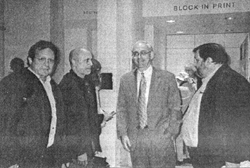
SYMPOSIUM ON MARION MAHONY GRIFFIN
HELD AT NORTHWESTERN’S BLOCK MUSEUM
By Sarah Downey
The long anticipated educational symposium on the life and work
of Marion Mahony Griffin drew scores of scholars and students
to Northwestern University on November 5, 2005. This symposium
was a highlight of the four-month long exhibition of her work
at the university's Block Museum of Art.
The discussion began with a presentation by James Weirick, professor
of landscape architecture at the University of New South Wales
in Sydney, who focused on the juxtaposition between Mahony’s
elaborate artistic style and its motifs, and the mystery of the
fundamental gaps the strange omissions and silences, as he called
them, found in her accounts of herself and her life with Walter
Burley Griffin.
Speaking next was Alice Friedman, professor of art and co-director
of the architecture program at Wellesley College, who placed Mahony
in the context of other female architects at the turn of the 20th
century, reflecting in particular on the dramatic story of Sophia
Hayden and her thwarted commission to design the Women’s
Building at the World's Columbian Exposition of 1893.
In the wake of those events, many held fast to the belief that
women weren't cut out for the profession, noted Friedman, and
it would be Mahony's innate talent, in conjunction with her later
associations with Frank Lloyd Wright and Griffin, that helped
her beat the odds. After lunch, Paul Kruty, professor of architectural
history at the University of the Illinois, Urbana-Champaign, examined
the origins of the Marionesque drawing style which became world-famous
as the way of presenting Wright's buildings and from which several
of her contemporaries culled inspiration, including Harry Robinson,
who became an expert at mimicking the style (indeed, Kruty argued
that one of the drawings on exhibition long thought to be by Mahony
was actually by Robinson). Kruty also showed how, through its
evolution, Mahony’s creation became a rendering style universally
associated with American architectural modernism.
Christopher Vernon, senior lecturer in the Faculty of Architecture,
Landscape and Visual Arts of the University of Western Australia
spoke extemporaneously about Mahony’s botanical artworks,
which complemented his thorough essay in the exhibition catalog
and revealed intriguing details about the friendships that helped
Mahoney thrive artistically and personally during some of the darker periods
following the project for the new Australian capital, Canberra.
An enlightened account of the period often characterized as
Mahony’s tragic widowhood came from Dr. Anna Rubbo, associate
professor in architecture at the University of Sydney. While devastated
by her husband's death, Mahony’s activities when she returned
to Chicago were representative of somebody who's actually having
an interesting time, and underscored by her work with social reformer
Lola Maverick Lloyd, who after her divorce from one of Winnetka's
most prominent men began to develop education-based communities
in Texas and New Hampshire for the World Fellowship Center.
Lloyd's death in 1945 would preclude Mahony from fully executing
those project designs, but afterward she devoted more time to
“The Magic of America”, the 1,100-page memoir she
completed in 1949. What started as a tribute to Griffin gave her
a chance to present her philosophy to the reader, noted Rubbo.
David Van Zanten, the Mary Jane Crowe Professor of Art and Art
History at Northwestern University and the person most instrumental
in shepherding the Mahony exhibition and symposium from its inception,
moderated the panel discussion that wrapped up the informative
and often exciting day.
Comments segued from the latest home prices in Castlecrag (astronomical)
to publication of ‘The Magic of America,’ (overall,
imperative). Weirick stated that he thinks the number one thing
is to get “The Magic of America” published, which
drew applause from many in the audience. As efforts toward that
end continue at the Art Institute of Chicago, visitors to the
Block Museum could see a few pages from the manuscript on display.
Debora Woods, the Block's senior curator, says at least 80 to
100 people a day have been coming to the exhibition since the
highly successful opening night in September. |
“A HOUSE IN THE SPIRIT OF THE TIMES”
Editor’s Note: Continuing the series begun in the last
issue of reprinting documents contemporary to Griffin’s
American practice, we offer here an essay by Griffin published
in “Country Life in America” (24 no.1, May 1913, p.38)
as part of a series entitled “My Ideal for the Country Home.”Following
his fame as winner of the Canberra competition the previous year,
Griffin was now chosen to be among a select group of prominent
domestic architects that included Wilson Eyre, Horace Mann, Myron
Hunt, and Harrie Lindeberg. As the example of his work offered
to illustrate his essay, Griffin chose the Benjamin Ricker house
in Grinnell, Iowa, site of this year’s Griffin meeting.
Rather than describe or explain the Ricker house in his essay,
which he titled “A House in the Spirit of the Times,”
Griffin used the opportunity to critique the course of contemporary
American architecture.
The basis of resemblance of the buildings of a place and period
is what constitutes an architectural style.
This basis cannot rest alone in physical utilitarian characteristics,
emotional aesthetic qualities nor in the intellectual stimulus
of associated thoughts, but concerns itself with the varying ratios
of all these three determining characteristics of a complete work
of art, so it must be evident that it cannot be in the individual
field of creative effort to consider style. That is a final resultant
of minds, forces, and time, and offers a proper study for historians
and philosophers.
It is admitted that the architect may consciously choose in
case of just one of his factors, the intellectual incident, to
appear to the educated tastes of traveled or book-informed clients
on the basis of some association. But that does not produce a
style, neither is it a democratic nor a reasonable course. Can
any one claim that it is necessary to the perpetuation or dissemination
of “The glory that was Greece, the splendor that was Rome”
to set up now their buildings made over to suit, as may be, our
practical every-day modern needs? Let’s preserve the relics
in museums, the records in libraries, and save the representation
for the theatres, or other branches of art so well adapted to
give us the thought, habits, and ideals of other times and places.
Would it not be better to free the architecture of our homes from
this impossible burden of a literary message, or language, if
you please?
Though one sex may wear “Empire” gowns and we can
store in our parlors a few duplicated “Louis XV” chairs,
we have already had to draw the line at “Tudor” heating
plants, “Renaissance” plumbing equipment and “Old
Colonial” illumination systems, and though we may boast
“Late Pullman” cars and “Early North German
Lloyd” steamships, fortunately we cannot take pride even
in nineteenth century automobiles nor “fin de siecle”
aero planes, so changing are our technical conditions and so limited
in capacity for literary encumbrance are these dynamic things.
But who can say for all that, that these latter creations may
not be beautiful and are not often surpassingly impressive in
their emotional appeal?
Every day new materials, new processes, new possibilities are
opening up before our imagination vast fields for exploration
and development, not only to our greater comfort and convenience,
but for the greater stimulus of our esthetic sensibilities and
the real joy of life.
So when the invitation is afforded in such a symposium as this,
though not able to answer as to proper styles in orderly fashion
because disputing the premises, I am glad to state why, summed
up as follows:
- Because individually selected associations in connection with
useful arts, not being democratic, can never be universal or
general and must result in a heterogeneous and mutually nullifying
collection of expressions. The home group is a work of useful
art where if anywhere harmony and quiet are most essential to
our well being.
- Because, moreover, the irrelevant idea of style has set apart
the architect into a mysterious aristocratic academic cult environment
where he is out of reach and touch with common life. This idea
of association in architecture not only distracts the designer’s
interest from fundamental aesthetic laws but diverts his attention
from and limits his freedom in availing himself of the innumerable
advantages in modern developments of construction which are
often only reluctantly adopted from material manufacturers,
builders, engineers and practical inventors who have had to
work blindly and often futilely without the architect’s
sympathy, his point of view, esthetic sense or training.
To instance architects’ slow avail of the opportunities
for interior freedom and openness afforded the house by circulation
heating plants, as opposed to the segregated cells necessitated
by the fireplace system, their adherence to primitive handwork
limitations in crude forms and constructive features, even to
faking defects on top of machine-finished precision for the sake
of peasant life traditions, is only to start a series of indictments
to be extended and filled out indefinitely by any observant critic. |
GRIFFIN IN GRINNELL, IOWA
The site of the 2005 annual meeting is one rich in associations
with the Griffins and the Prairie School. For this Iowa farming
community and college town, Griffin created three separate projects
during 1910 and 1911: a public fountain to memorialize Dr. E.
W. Clark, a recently deceased local doctor; a large residence
for Benjamin Ricker, a glove manufacturer; and a subdivision plan
for the northern edge of town.Important pieces of the puzzle that
were necessary to understand the relationship among these three
were missing until Paul Kruty and Paul Sprague undertook the research
for their catalog of the American work.
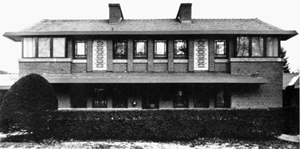
The Ricker house, constructed in 1911, was one of the first projects
on which Walter and Marion Griffin worked together as husband
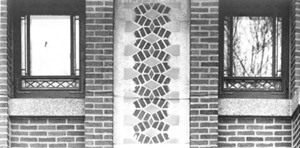
and wife. It is the first building from Griffin’s office
to include decorative ornament set in panels on the façades,
in this case, in the form of colored Teco tiles and brick. As
this is similar to the treatment found on the façade of
the Robert Mueller house, designed by Marion Mahony for Hermann
von Holst before her marriage to Griffin and built in Decatur,
Illinois, it is presumed that she added those touches to the exterior
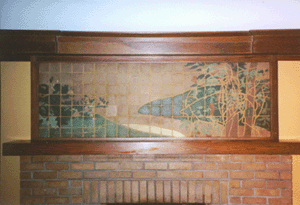
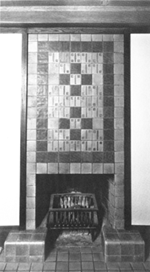
here. Inside, she created an abstract fireplace mural of Teco
tiles in the library that has long been admired. However, the
existence of a second, representational tile scene was not known
until restoration work on the house began in 2001, when it was
discovered that a version of the famous Mess house mural was preserved
under a plywood board that had been added many years ago above
the living room mantel.
All of this was accomplished by the Griffins before Louis Sullivan’s
Merchants National Bank was built on the corner of Fourth and Broad
streets in 1914. One of the most famous of Sullivan’s later
“jewel boxes,” the bank has been restored and adapted
for use by the Grinnell Chamber of Commerce.
|
SOCIETY SALVAGES WINDOWS FROM GRIFFIN'S MARSH HOUSE
The Society recently acquired the surviving casement windows
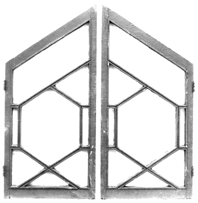
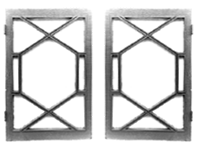
from the James S. Marsh house built in 1910 and demolished in
2003. The Marsh house stood in the north shore village of Winnetka
until it became another victim of the "tear-down" fever
ravaging the historic neighborhoods of Chicago and its suburbs.
On a clear Sunday morning, Chicago's Cultural Historian Tim Samuelson
accompanied board members Mati Maldre and Paul Kruty to the muddy
site to rescue the windows, which are decorated with Griffin's
characteristic wooden muntins set as a central hexagon surrounded
by pairs of triangles and rectangles with pentagons in the four
corners. The Marsh house stood in the same development in which
Griffin's Orth Houses, the "Solid Rock" house, and two
other speculative houses still stand. Its loss was particularly
unfortunate and is deeply felt by admirers of Griffin's work everywhere.
After the Griffin Society, the City of Winnetka, and various preservation
groups were unable to convince the owner to save the house (and
without the legal authority of a local landmark ordinance to intervene),
the Griffin Society was able to salvage a group of windows for
dispersal to appropriate historical societies and museums.
The Society owes a debt of gratitude to James Soukoulis, owner
of the property, for allowing the windows to be saved. Thus far,
windows have been donated to the Ridge Historical Society, which
serves the Beverly/Morgan Park neighborhood; the McNider Museum
in Mason City, Iowa, which hosted last year's annual meeting;
and the Stockman House Foundation, also in Mason City.
The prototype for the lost Marsh house still stands in Chicago's
Beverly neighborhood: the house at 1712 W. 104th (Griffin) Place,
built by developer Russell Blount and sold to Edmund Garrity.
After Griffin prepared the design for Blount, who constructed
it in the spring of 1910, he offered a similar design to William
Tempel, who was simultaneously developing the family property
in Winnetka. Tempel arranged for its construction later in the
season and found a buyer in James Marsh.
The Society plans to continue distributing the windows until
homes have been found for all of them. For information, please
contact the Griffin Society at 1152 Center Drive, St. Louis, MO
63117, e-mail: info@walterburleygriffin.org.
|
|